Aug 1, 2014

A week in South Africa

24 May 2014 (Saturday) -After 14 hours of travel with 12 hours and 55 minutes of  uninterrupted feet numbing plane experience from Hongkong, finally I was in Johannesburg, South Africa. I was fetched by Daddy of Sol-Ant Travels and brought me to my hotel in Pretoria where I spent my entire seven days. 

En Route from O.R. Tambo International Airport to Pretoria

The view from my room in Southern Sun Pretoria Hotel
The fancy hotel room 
The day I arrived was South Africa's 5th democratic president,Jacob Zuma's inauguration. Unlike any other country in the world, South Africa has three governmental capital cities: Cape Town, Pretoria and Bloemfontein. I was fortunate enough that the hotel I was staying was few blocks away from the Union Buildings where the celebratory inauguration events were being held. The streets were brimming with locals chanting and dancing- it was very festive but at the same time  jammed with people that I couldn't even inch through the large crowd so I decided to go to the Church Square instead. 

I especially enjoyed my visit to the Church Square where 19th century architecture outlined the historical center (and the friendly Africans who were consistently calling me a Chinese :) ).
Old ZAR Council Chamber (1891)

Standard Bank (1934)

The Palace of Justice (1902)

The Statue of Paul Kruger (1896)
Tudor Chambers (1904)
After the Church Square, I went to the Kruger Museum which was originally Paul Kruger's house. Since everyone was at the Union Buildings, it was nice to be the only tourist in the museum. 

The Kruger Museum, Pretoria 

In front of the Kruger Museum- one of my few personal snapshots in South Africa. 

 The Krugers' Horse Carriage
Some of Kruger's artifacts

Since I had few time left in my Saturday afternoon, I went to the Pretoria Art Museum but it was already closed when I got there. Surprisingly, the Pretoria Art Museum was adjacent to the Arcadia Park and spent the rest of my afternoon before finally settling back in the hotel.
Olmec Replica Statue
Color is definitely one of Africa's main attractions in nature and culture
25 May 2014 (Sunday)- Today, I visited the Union Buildings,  the Voortrekker Monument, Freedom Park and the Pretoria Art Museum.

Words can never perfectly describe the vastness and magnificence of the Union Buildings.


 The Voortrekker Monument found on a hilltop south of Pretoria is another impressive architectural structure. This monument took 11 years (1938-1949)  to build in commemoration of the Voortrekkers.


One of  Voortrekker Monument's two main features: Historical Frieze

Voortrekker Monument's second main feature: The Cenotaph. On top of the  building is an opening where the rays of the sun directly shines at the center of the Cenotaph at noontime every 16th of December. 
After the Voortrekker Monument, I went to the Freedom Park and visited the Hapo Museum and the Garden of Remembrance. One distinct characteristic of the Hapo Museum is that it recounts the history of the African people and their struggles for freedom.

Here are few pictures I took inside the Hapo Museum and the Garden of Remembrance:


The 697 meter long Wall of Names 

The Garden of Remembrance
The view of Pretoria and Johannesburg from the Freedom Park
My last stop of the day was the Pretoria Art Museum (finally!).


26- 30 May 2014-  Management Sciences for Health's Global Monitoring and Evaluation (M&E) Workshop- A whole week of meeting colleagues and learning with esteemed M&E professionals around the world. I am very grateful to be given an opportunity to learn about recent trends in data visualization, evaluation methods and operational researches.

MSH M&E Colleagues

With Neusa Bay (SIAPS Technical Advisor) of Mozambique and Dr. Obakeng Khaole (Senior Technical Advisor TB Services Support) of South Africa

With Tobey Busch (SIAPS Technical Advisor) of Arlington, USA

On my last night in South Africa, I had a  safari tour in the Lion Park in Johannesburg. I enjoyed the safari tour while we bravely wandered around the park at night. Aside from the lions, there were cheetahs, wild dogs, hyenas, leopards, zebras, antelopes, giraffes freely roaming around the park and I greatly enjoyed the thrill of having the animals follow our game vehicle.

The glorious Johannesburg sunset on the way to the Lion Park

With the  lion cubs

The Lionesses

The King of the Jungle selfishly devouring his meal.

With the best Safari tour, Mr. Steve Stephansen of Africa Explore Tours& Safaris
This is my favorite South African shot (by far) taken by Steve and  as he said "At least we know that giraffe is really tall."

Dec 8, 2013

Love in Transit

At Changi Airport- November 23, 2013

The clouds aligned the clear horizon as the trees steadily tower to reach the blue ceiling. Serene pauses, blank thoughts, lonely spaces- they seem to populate my waiting hours.

Long foregone were the fleeting hours when love drives my existence. I am starting to get used to my own reclusive space. I am getting used to be alone-- just alone.

I am listening to this song hoping that as the strings are plucked one by one, it creates this chaotic harmony - a melody that will reverberate into your memory the remembrance of you and I. You and I, but not together.

I am miles above the earth being jostled back to wherever that defined the distance and separation. One day, if the universe permits but a "one space", I hope I can look at you without neglect or pretensions of happiness. I can joyfully say to you that I have loved you- in past tense without expectations.

For now, I only have myself and this mind that has nothing but a million and one jibberish unstrung words. When I am into my own world, I delight not in conversations but in silence, I thrive not in sharing my personal space but in watching from a distance people in transit, love in transit.

There's something wonderful with strangers' faces: unruly hair; moles in the right places and oh that favorite mole just above the upper right lip; button-wide nose and dark circles around the eyes. Eyes staring away. Strangers' eyes  staring at me and telling but a million thoughts- conveying stories on how good it was waking up besides someone who was not drunk the night before or  stories on how coffee defied its purpose of being just a "coffee" or how it was to feel the warmth of another hand interlocked in their own fingers.

The displacement of this strong emotion compels me to look at myself in the mirror- unruly hair; mole just above the upper right lip, button-wide nose and dark circles around my eyes. Eyes staring away- far away where love has gone to. I hope one day I can joyfully say to myself that I have found the love again- over and over again.

Aug 29, 2011

The Life of a Roomie in Mongolia

I was sixteen years old when I first experienced sharing a room with other people. I had never shared a room with my two siblings so imagine how scary that experience was. I stayed in a boarding house in Paco, Manila for almost seven years during my undergraduate and  hospital years.The boarding house as I vividly remember it, may take in twenty boarders ( males and females) and each floor has a communal toilet, bathroom, kitchen, living room, T.V set and refrigerator.

People moved in and  out of our room, and for seven years I believe I perfected how to be someone's roomie. I mastered how not to use their toothbrushes to clean the sink drain, how  not to hang their clothes in the balcony during Signal No. 3s and how to control myself from eating their Toblerone and Chinese take-outs in the refrigerator. I think being a roomie is one of my best skills probably just third to intravenous access insertions and sleep talking.

Not until six months ago when I moved into this posh apartment that I  was confronted by the same fear I had ten years ago.I admit that I did hesitate to be someone's roomie again especially that I had only started adjusting in this totally new country. I thought I perfected the skill of being a roomie but when I stepped into the apartment, it felt like I was back in my old sixteen year old self. Everything was new: work, culture, people and food; and dealing with a new person at my personal security zone was the least I could hoped for.

Honestly, I was thankful that being Farrah's roomie had helped me adjust in Mongolia better.I am fortunate that my first six months were spent with someone of the same culture and inclinations. As cheesy as it sounds, my six months with her made me enjoy that crucial transition period.

Because of her...

Saturdays in Tengis or Urgoo Cinema had made me enjoy:  I am Number Four, Adjustment Bureau, Source Code, Rio, Kung Fu Panda, Captain America and Harry Potter 7 (Part 2) on a widescreen.

I enjoyed cooking in the kitchen since I knew she will never complain on whatever I came up with ( as long as there is rice).


I don't have to worry on a room mate in a ger
During VSO Mongolia Summer Conference 2011
Sainshand, Gobi trip, June 2011

or a seatmate in the bus during long trips.


I am grateful of meeting Khulan and Nyamka, her Sunday students.
With Khulan during our National Museum visit
I realized that Fanta was the next best soda after Coke- and that we actually stopped our addiction for three weeks because of ulcer-like symptoms.

Bacon and eggs are best not only during breakfasts but most especially during the last weeks of the month (when there's no more allowance left).

I had someone to watch Mongolian or Russian dubbed television shows without looking so stupid.

and finally,  because of her, I had someone to talk to about my one million and one frustrations at work.


Last week, she went back to the Philippines after completing her year of placement here in Mongolia. The life of  being Farrah's roomie was finished and now as I am nearing my half placement mark, I am excited to start my life as Liz's roomie ( a new VSO volunteer from England).

Aug 19, 2011

Done with the visits

It's been awhile since my last post. I won't deny that I had been so busy with a lot of things and one of which was visiting all 24 khoroos in Bayanzurkh District. Ideally, as soon as a new volunteer steps into any community, he/she must conduct a needs assessment by visiting all the Family Group of Practices (FGPs) in the first two months. An FGP is the usual barangay health center in the Philippines.

My visits took at least 5 months, just in time  before the new volunteer comes in.  So, with the help of my interpreter Altai and the FGP Manager Sugar (both in their stilettos braving the steppes for hours), I finished my visits and finally realized what's in "it" for me. And I tell you, I am in a massive "it"and massive is an understatement.

To start with, this district has approximately 290,000 "registered" people- not counting the families who have put up their gers a few minutes ago and the families who have left  to move to another district (modestly explaining their culture of moving in and out). And mind you only six of these FGPs are apartment khoroos while the rest are ger khoroos. The good thing is that here they have the freedom of putting up their ger anywhere they want unlike in Manila, where people living in the squatters would have to fear for their lives because of  demolition or a rushing train. Migration is a big problem as more and more people from the countryside move to the city to find a stable job- also a situation in my country.To resolve this gap, the khoroo government is trying its best to have everyone registered for the advantage of being able to access health services but the lack of manpower in the khoroo is crippling.

During my visits, I usually interview the heads of the FGP and they were all singing the same chorus. " Not much doctors or nurses for at least 10,000 people", "doctors and nurses are overworked", "doctors and nurses are underpaid", "In a day, one doctor sees 50 patients", and the song seems to never fade. It's incredible to know that I'm new in this community but very much familiar of the song they are singing because of what I witnessed while working with much, much smaller communities in the Philippines (probably 100 times much smaller).

One of the most obvious difference though is that Mongolians usually seek consultations for injections unlike us Filipinos who would rather swallow a month of irritating tablets just to avoid those injections.In almost 80% of my visits, I  witnessed seemingly healthy people coming into the clinic with a plastic bag of IV drips and 100% of those times, I would pester my interpreter to ask what the IV drips were for. But all the time, I would be in a glorious defeat because my interpreter was too courteous to ask. After twenty minutes of IV infusion, these seemingly healthy people will resume their seemingly normal lives and will leave the seemingly busy FGP- without a single tear. One time, I tried my best to look at the IV drips but as much as I tried transposing my left and right eyeballs , I could not understand the Mongolian scripted labels and so I stopped snooping around before I got caught.

I have to say that I am quite impressed with how their FGPs are completely endowed with children's playrooms, exercise equipments, digital scales, ultrasound and echocardiogram. But during my interviews, I had found out that they don't usually use these equipments because they don't have someone in the FGP knowledgeable on how to use it. Not only do they have not enough manpower in the FGPs, they also lack the "right" manpower.


And so after five months, I finally realized how big would be the ripples of my small actions. I admit that  the communities I had worked with before was just a fraction of this district's population. I know that I am not here to give them solutions on their big problems but then now I realized how important would be the implementation of our project.

Just in case you haven't heard from me for quite some time, don't worry, I'm just too busy with my small ripples. And oh yes I might be busy hanging out with my ex-lover:

Jul 19, 2011

An unconventional way to celebrate Naadam

 I was told  how Mongolians celebrate their holidays: extravagant, colorful and loooonnnnggg. And so after spending exactly eleven days of not seeing the cold basement office that housed me for more than five months now, I am back with nothing but a joyous remembrance of my first Mongolian holiday: the Naadam.As early as Thursday before last week, everyone was in no mood to work ( since three of our counterparts were already on leave until August and one will come back on October). Upon saying this, I think it was just rational to have joined their bandwagon and besides cultural adaptation is one of the best perks in international volunteering (wink wink).

Naadam or locally termed as " Eriin gurvan naadam" is a national holiday where Mongolians showcase the "three games of men": wrestling, archery and horse racing.Aside from these competitions, this year marked the 805th year of the establishment of the Great Mongol Empire by Genghis Khan and the 90th anniversary of their independence. But unlike the swarming of tourists and expats to the stadium to witness the elaborate and extravagant opening ceremonies of Naadam here in UB last Monday, I only had a glimpse of it in our living room like a true couch potato. The opening ceremonies was a cultural sight as there were parade of men and women in colorful deels, procession of children riding horses, traditional dances, ensemble of people playing the Morin-khuur and a lot of throat lip synching.

The title of this post said it all, this is an unconventional way to celebrate Naadam since I was not able to see not even a single sport event. But I admit that I was more excited in our half week-long trip to Arvaikheer and Kharkhorin. At the end of the first day of Naadam, two rainbows and a 30 minute firework display graced the skies and the  festivities of the whole city. 

Two rainbows highlighted the first day of Naadam
The other half of the rainbows
A good view of the fireworks display at the 10th floor
 
Last Tuesday, along with five of my Filipino friends, we had set out on a spine-numbing ten hour bus trip to Arvaikheer. We were giggly and loud while we tried to tolerate the excruciating length of the trip. It was extra uncomfortable for me since I had a full bladder for 4 hours. One of the things that I should learn though while I am here is how to urinate in the fields or open-pit latrines during trips.

 Like my Sainshand trip, the scene on our way to Arvaikheer were constant: steppes, flat lands and herds but more colorful with the help of this fancy drapery.
Spicing up the view outside were some dainty drapery
 The bus had a couple of stops along the way; one of which was when the whole road was blocked by some policemen for half an hour because of a horse racing event. So here were some of the pictures during the stops( courtesy of Jovy Rabara).
The horse racing event on our first stop

With some locals on their deels during our bus stop
Posing in front of our Ovorkhangai bus

After ten hours and countless of bus stops, we arrived in Arvaikheer and were all welcomed by the rain. We stayed at Bunny's apartment for two days and roamed around their small town. From July 11- 13, Naadam was declared a national holiday even though most of the provinces have different schedules of Naadam. Like most of the towns here in Mongolia that have massive land area, Arvaikheer has proved that a town with a population of 24,000 in a land area almost as big as the whole province of Zambales can be as deserted as a ghost town especially during holidays.

With our driver at the Arvaikheer Welcome Sign ( Photo Credits: Jovy Rabara)

Arvaikheer Soum Hall
The day after, the six of us were jammed up in a small car and went to Kharkhorin- Mongolia's ancient capital city. It took us four hours to get there because we needed to snatch a snap of the sceneries and the herds and not to mention getting lost in a short-cut.

Jammed up with Bunny, a VSO volunteer working in Ovorkhangai

A Herd of Camels (Photo Credits by Jovy Rabara)
My first time to see "Yaks"
More herds of sheep and goats
Mongolians are famous for being "daredevil" drivers. So before we arrived in Kharkhorin, it felt like my stomach, gallbladder, pancreas and intestines were all tied up in a nasty knot. I could even remember the  taste of my puke with a tinge of bile on it. 
It was already 1 p.m when we reached Kharkhorin. We managed to book the Friday bus tickets back to UB, had some decent lunch in the cheap ger camp we stayed and then drove around the city after our "Beefsteak" lunch.
First Stop: The Phallus Rock ( Rock Penis)


At the site of the Phallus Rock, there were stalls selling antique souvenirs and coins which we initially thought should be in museum but were "good fakes" according to one Israel archaelogist we met on our way home.


Second Stop: Kharkhorin Museum

Not much to say about the museum since we did not go inside- proving Filipino's value of thrift or to be more specific: Filipino volunteers' value of thrift.


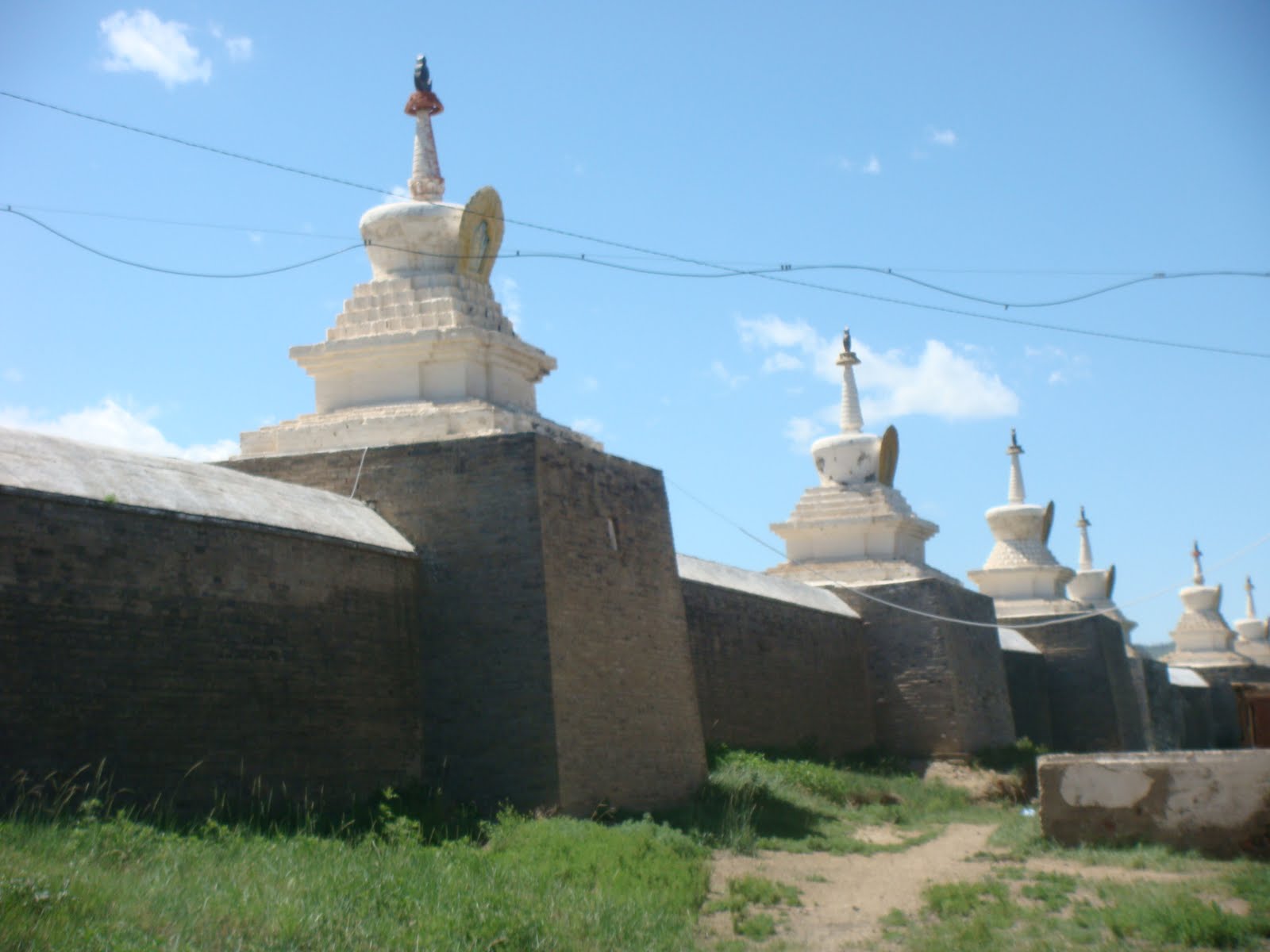
Next, we went to the Erdene Zuu Khiid ( Hundred Treasures) which is the first Buddhist monastery in Mongolia that was established in 1586.This monastery was confined by walls and 108 stupas. Before its destruction in 1937 by Stalinism, the monastery housed 60 to 100 temples but now there were only three temples left: Baruun Zuu, Zuu of Buddha  and Zuun Zuu which were said to be dedicated to Buddha's three life stages: childhood, adolescence and adulthood. Now, Mongolians are keen in restoring their lost treasures so few restorations were already visible. If you are interested in helping out with the restoration by donating money, I will be happy to inform you how.

Here are some of the pictures I took inside the monastery:


600 meters outside the Erdene Zuu Khiid, a turtle rock awaited us. The Lonely Planet Guide said that there were two turtle rocks in Kharkhorin believed to protect the city, the other one is near the Phallus Rock but we were not able to go there.


So after an hour or so of walking in and out of the monastery, here we were at our final Erdene Zuu Khiid stop:
Photo Credits: Jovy Rabara

Ooops, I almost forgot the birds we saw at the entrance. look how big their claws are, just enough to grind your hand.


After Erdene Zuu, we went back to our ger, bid our goodbyes to our driver, rested for a few hours and wandered around the once glorious city of Kharkhorin.What more could be a best end of our first day in Kharkhorin than a full moon in a starless sky.


The next day we packed our things and met our 10 a.m bus schedule, all fully pumped up to start another week in a foreign land.

Share This!